Winning AI Citations When Legal Reviews Every Sentence
By Jeff Jenkins
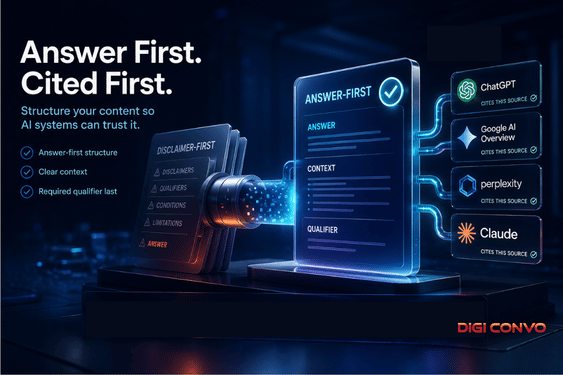
In regulated industries, the pages Legal scrutinizes most are often the ones AI cites least. Here is the answer-first structure that keeps every required word and still gets you cited.
<h2>Why the pages your lawyers worry about are often the pages AI trusts most.<br></h2><p><br>In regulated industries, your most carefully reviewed pages are often the least likely to be cited by AI. Every line cleared Legal, yet the same caution that protects the company can also make those pages harder for AI systems to use. This is not a content problem. It is a structure problem, and you can fix it without cutting a single word your lawyers require.</p><h2><br>TL:DR</h2><ul><li><p>AI visibility is a structure problem, not a content volume problem.</p></li><li><p>Legal review often buries the answer beneath qualifiers, making it harder for AI to cite.</p></li><li><p>Lead with the answer. Follow with context. End with the required qualifier.</p></li><li><p>Your highest-intent pages are often your biggest AI citation opportunities.</p></li><li><p>Keep every word Legal requires. Change only the order.</p></li></ul><h2><br><br>The Tension Nobody Names: Compliance Versus Answerability</h2><p><br><br>If you market a regulated product, you are not short on content. You publish constantly, and every line has cleared review. Yet when a buyer asks ChatGPT or Perplexity a question you have answered a dozen times, your competitor shows up, and you do not.<br><br>The reason is not effort, and it is not that your content is wrong. Legal review is optimized for defensibility. It hedges the claim, qualifies the scope, and leads with what the reader should not assume. That instinct protects the company and also produces sentences that an AI system cannot use.<br><br>Your content has two jobs that pull in opposite directions. It has to satisfy the regulator, which rewards caution and qualification. And it has to satisfy the machine, which rewards a clean, standalone answer.<br><br>Most regulated pages do the first job well but not the second at all. The startup that beats you to the citation is usually not more accurate. It is just easier to quote.</p><h2><br><br>Why Disclaimers Bury the Answer</h2><p><br><br>To see the problem, you have to view the page as an AI system does. It is not reading top to bottom the way a person does. It is much more likely to rely on a clear, self-contained statement that answers the question than on a paragraph wrapped in qualifiers.<br><br>Now picture a page that opens with eighty words of "nothing contained herein constitutes financial advice, and eligibility is subject to underwriting, terms and conditions apply." Too often, the clearest extractable statement on the page is the disclaimer rather than the answer. When that is the case, your page becomes easy to pass over, and the answer is much more likely to come from a competitor whose page leads with a clear one.<br><br>The disclaimer is not the problem.<br><br>Its position is.<br><br>You do not need to remove a single word your attorneys require. The words do not need to change.<br><br>Only the order does.</p><h2><br><br>The Fix: Answer-First, Disclaimer-Last</h2><p><br><br>The change is small and almost mechanical. Lead with the answer. Follow with the context. Put the qualifier at the end, where it still does its job.<br><br>Here is a paragraph shaped the way review often produces it. The buyer's question is simple: is my money insured?</p><h3><br><br>Before</h3><p></p><p>Nothing on this page constitutes financial, legal, or tax advice. "Company" is a financial technology company, not a bank. Banking services are provided by "Partner Bank", Member FDIC. FDIC insurance is subject to applicable limits and conditions, is not provided by "Company", and applies only to the failure of the insured depository institution. Subject to the terms of your account agreement, funds held in your account may be eligible for FDIC insurance up to $250,000.<br><br>Every word is defensible. The problem is that the answer comes last. It is the one thing both a buyer and an AI system are looking for, yet the first thing on the page is a disclaimer.<br><br>Now the same facts, reordered. Not a single required word removed.</p><h3><br><br>After</h3><p>Yes. Funds in your "Company" account are eligible for FDIC insurance up to $250,000. "Company" is a financial technology company, not a bank. Banking services and FDIC insurance are provided through our partner bank, "Partner Bank", Member FDIC, and coverage applies in the event of that insured institution's failure, subject to the limits and conditions in your account agreement. Nothing on this page is financial, legal, or tax advice.<br><br>The qualifiers are all still there. Legal still has the "not a bank" line, the partner-bank attribution, the coverage limits, the advice disclaimer. What changed is that the answer now comes first. A reader gets it in one sentence. So does a machine.<br><br>The example is illustrative. The structure is the point: answer first, then context, then qualifier.<br><br>This is Publishing for Two Readers in practice. The regulator reads a page that contains every protection it requires. The machine reads a page that opens with a clean, self-contained answer. You are no longer choosing between them.</p><h2><br><br>The Pages AI Reaches for Before the Sale</h2><p>The pages most worth restructuring are the ones Legal guards most closely. That is not a coincidence. The pages under the heaviest review are usually the pages answering the highest-intent questions.<br><br>Think about the questions a serious buyer asks once they begin evaluating vendors, and where those answers live:<br></p><ul><li><p>"Is it secure?" and "Are you SOC 2 compliant?" live on your security and trust center pages.</p></li><li><p>"How much does it cost?" lives on pricing.</p></li><li><p>"How long does implementation take?" lives on your implementation and onboarding docs.</p></li></ul><p>"Can I trust this company with regulated data?" lives on your compliance pages.<br><br>These are decision-stage questions. They are also the <a target="_blank" rel="noopener noreferrer nofollow" class="text-primary underline" href="(https://www.prnewswire.com/news-releases/consumer-reliance-on-ai-search-results-signals-new-era-of-marketing--bain--company-302379679.html">questions buyers increasingly ask AI</a> before they ever visit your website. And they map almost exactly onto the pages companies tend to gate, bury in a PDF, or write in the most defensive language they own.<br><br>That is the opportunity. The page your compliance team scrutinizes most closely is often the one that answers the question most directly related to the sale. Apply answer-first to it, and you become the source AI reaches for when a buyer is making a decision. Leave it buried, and you hand that moment to whoever wrote a cleaner version.<br><br>I have seen this play out. A well-structured trust or security page can surface in an AI answer where a more polished marketing page does not, simply because it answers the question directly.</p><h2><br><br>The Self-Audit</h2><p><br><br>None of this requires going around Legal. It works better when Legal is in the room, because the fix is a structure they can approve once and apply everywhere. Give them a default template, and review gets faster, not slower.<br><br>Run each page through a short self-audit. Ask:<br></p><ul><li><p>Can someone read the first two sentences and answer the question?</p></li><li><p>Do the disclaimers come after the answer, not before it?</p></li><li><p>Would the key sentence still make sense if it were quoted on its own?</p></li><li><p>Did you keep every word Legal requires and change only the order?</p></li><li><p>Are your evaluation answers published on the page instead of hidden in a PDF?</p></li></ul><p>Can both a person and an AI quickly find the answer?<br><br>If you can check those boxes, the page serves both readers simultaneously.<br><br>That is Publishing for Two Readers.</p><h2><br><br>Cross-Vertical Examples</h2><p><br><br>The example above is fintech, but the pattern is not. Every regulated industry produces disclaimer-first content for the same reason: the safest legal structure is rarely the easiest structure for a buyer or an AI system to understand.<br><br>In fintech, the qualifiers pile up fast. Rates are variable; deposits are subject to FDIC conditions; loans are subject to credit approval. The more disclosures a page needs, the easier it becomes to bury the answer beneath them.<br><br>In healthcare, the tension is between general evidence and individual outcomes. A treatment can be well supported in the literature and still carry "results vary." Lead with what the evidence shows, then individualize, rather than opening with the caveat and never quite stating the finding.<br><br>In insurance, the honest answer often changes by state. That is a reason to lead with the general answer, then localize it, not a reason to open with "coverage varies by state" and leave the reader with nothing.<br><br>In legal, the disclaimers are not a caution; they are ethics rules. Bar advertising restrictions mandate specific notices. The rules are non-negotiable, and they still do not have to come first. Answer the prospect's question, then carry the required language.<br><br>Different constraint, same method. The regulator's language stays intact. The answer moves to the front.</p><h2><br><br>FAQs</h2><h3><br><br>Do I have to remove my disclaimers to get cited by AI?</h3><p>No. You keep every word your legal team requires. You change the order, not the content: the answer comes first, the qualifier comes after.</p><h3><br><br>Will Legal push back on this?</h3><p></p><p>It tends to go the other way. The fix is a structure Legal can approve once and apply everywhere, which makes review faster, not slower. You are not asking them to drop a protection. You are asking them to place it after the answer, not before.</p><h3><br><br>Where should I start?</h3><p></p><p>Start with the pages that carry the highest intent and the heaviest review: security, compliance, pricing, implementation, and trust center pages. Those hold the questions buyers ask AI right before they decide.</p><h3><br><br>Will this work for AI Overviews, ChatGPT, Claude, and Perplexity?</h3><p></p><p>The principle is platform-independent. Every AI system performs better when it can find [a clear, self-contained answer supported by the surrounding context](https://static.googleusercontent.com/media/www.google.com/en//search/howsearchworks/google-about-AI-overviews.pdf). The underlying retrieval methods differ, but the publishing pattern stays the same.</p><h3><br><br>Is this just SEO with a new name?</h3><p></p><p>It builds on the same foundations, but the target is different. Traditional SEO focuses on ranking a page. This helps make a clear answer easy to extract and cite within an AI-generated response. Same discipline, new surface.<br></p><h3>Who this is for:</h3><p><br><br>This article is written for marketers working in regulated industries, where every published sentence must survive legal review. If that is your world, this approach lets you improve AI visibility without weakening compliance.<br><br>The words do not need to change.<br><br>Only the order does.<br><br>The approach described here is one component of a <a target="_blank" rel="noopener noreferrer nofollow" class="text-primary underline" href="https://digiconvo.ai/methodology">broader AI visibility methodology</a> for regulated industries.</p><h2><br><br>Key Takeaways</h2><ul><li><p><strong>Lead</strong> with the answer before the qualifier to make your content easier for AI to extract and cite.</p></li><li><p><strong>Restructure</strong> compliance-heavy pages instead of rewriting them to improve AI visibility without weakening legal protections.</p></li><li><p><strong>Prioritize</strong> security, pricing, compliance, implementation, and trust center pages because buyers ask AI those questions before deciding.</p></li><li><p><strong>Partner</strong> with Legal on a repeatable page structure that speeds review and preserves every required disclosure.</p></li><li><p><strong>Change </strong>the order, not the words, to satisfy both regulators and AI systems.<br><br><strong>Author Bio</strong><br><br>Jeff Jenkins is the founder of <a target="_blank" rel="noopener noreferrer nofollow" class="text-primary underline" href="https://digiconvo.ai">DIGI CONVO</a>, where he helps fintech companies improve their visibility in AI-generated answers. He writes about AI visibility, entity strategy, and the future of buyer discovery.</p></li></ul><pre class="bg-muted p-4 rounded-lg font-mono text-sm"><code></code></pre><p></p>
- AEO
- GEO
- AI visibility
- regulated industries
- fintech marketing
- compliance content
- answer engine optimization