Why Authentic Video is Better For AI Visibility than Stock
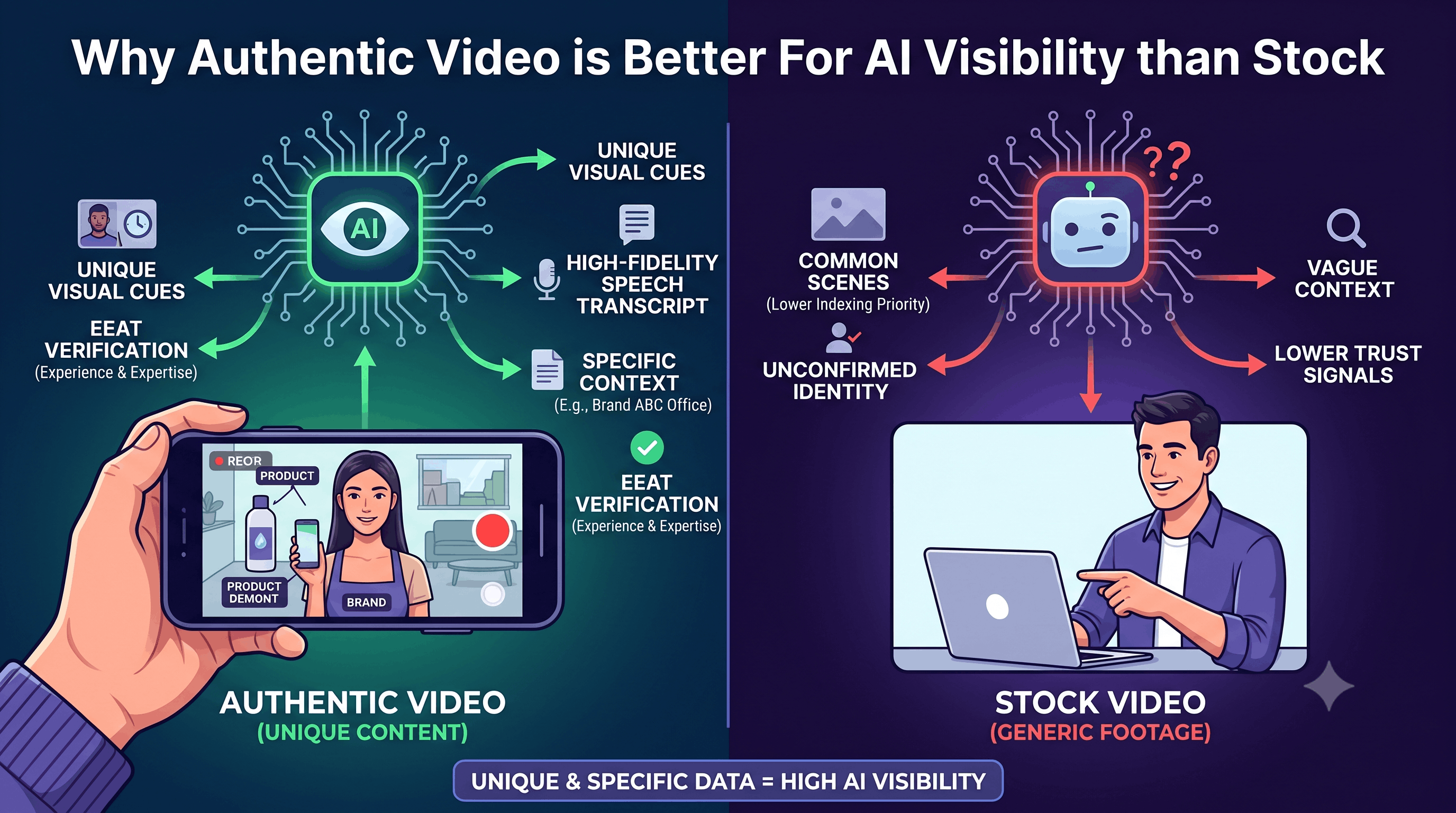
Authentic video, video made with a dedicated Subject Matter Expert or SME has been proven to perform better in AI search because there's a verifiable name and a source that AI search engines can cite. We'll be breaking down this and more in this article. Hope you enjoy.
<p><br>You've had it happen. Someone sends a friend request and the profile photo is the platform's default gray silhouette, no face, no name behind the name. You hesitate before accepting, if you accept at all. That small flash of doubt is close to what an AI search system runs into when it evaluates a brand with no video: a source without a person behind it. This was one of the main points brought up by <a target="_blank" rel="noopener noreferrer nofollow" class="text-primary underline" href="https://discoveraio.com/directory/kayleigh-crandell">Kayleigh Crandell</a>, Xponent21's Social Lead and Project Manager during our last webinar. And we're going to take a deeper dive into that point to show why you should always think about posting authentic videos for your brand. <br></p><p>Authentic video builds AI search visibility because it gives an AI system three things a brand can't fake: an identifiable author, demonstrated first-hand experience and evidence that other people trust what that author says. Stock footage and faceless brand videos cannot produce any of those three signals, regardless of how much the production costs. That's why a shaky, unscripted clip filmed on a cell phone camera has the capability to out-cite a six-figure brand film for the same search term. It's a specific, testable claim about what citation systems reward, grounded in mechanism rather than taste.</p><p><br><br><br></p><h2><strong>What is a Faceless Brand? </strong></h2><img src="https://access.discoveraio.com/storage/v1/object/public/public-assets/email-images/AdobeStock_1983125630.jpg" alt="" class="editor-image max-w-full h-auto rounded-lg cursor-pointer transition-all hover:opacity-80" draggable="false" style="max-width: 100%; height: auto;"><p>A brand with no video looks the same to a visitor as a stranger with a gray default avatar looks on social media. Kayleigh made the comparison directly during <a target="_blank" rel="noopener noreferrer nofollow" class="text-primary underline" href="https://youtu.be/67Rymo7BeKk?si=uCpCsm7eNfB6G7QS"><u>Video for Visibility in the AI Age</u></a>: our last webinar. Somebody friends you on social media and, in her words, "they just have a gray face." You accept that request less readily than you would for someone showing a real photo. The comparison holds because the underlying behavior is identical: people, and increasingly AI systems, extend trust to a source they can identify, and withhold it from one they can't.</p><p>Text alone cannot fix the issue. A well-written bio establishes credentials on paper, but it doesn't show a real person answering a real question in real time, which is exactly what builds the kind of trust that gets referenced back at a user. That's the mechanism behind putting subject matter experts on camera: a name attached to a face attached to a brand creates a specific, checkable identity, something a byline alone can only gesture toward. For a deeper look at how AI systems evaluate who gets cited and why, we have an article just for this; <a target="_blank" rel="noopener noreferrer nofollow" class="text-primary underline" href="https://discoveraio.com/articles/ai-seo-explained-how-modern-search-engines-decide-who-gets-cited"><u>AI SEO Explained: How Modern Search Engines Decide Who Gets Cited</u></a> covers the authorship half of this equation in more detail.</p><h2><br><br><strong>Why AI Search Rewards Authentic Video Authorship Over Production Value</strong></h2><img src="https://access.discoveraio.com/storage/v1/object/public/public-assets/email-images/Authentic_Video_SMEs_Faces_to_Brands.png" alt="" class="editor-image max-w-full h-auto rounded-lg cursor-pointer transition-all hover:opacity-80" draggable="false" style="max-width: 100%; height: auto;"><p></p><h3><strong>What AI Systems are Actually Weighing When They Choose a Source</strong><br></h3><p>What AI search engines look for in video content starts with the same fundamentals Google has published for years about written content, now applied to a format that makes those fundamentals harder to fake. Google's own <a target="_blank" rel="noopener noreferrer nofollow" class="text-primary underline" href="https://developers.google.com/search/docs/fundamentals/creating-helpful-content"><u>Search Central guidance on creating helpful, reliable, people-first content</u></a> asks site owners to consider whether "it is self-evident to your visitors who authored your content," whether pages "carry a byline, where one might be expected" and whether the content "clearly demonstrate[s] first-hand expertise and a depth of knowledge, for example, expertise that comes from having actually used a product or service, or visiting a place." Google groups these questions under what it calls <a target="_blank" rel="noopener noreferrer nofollow" class="text-primary underline" href="https://discoveraio.com/faqs/what-is-eeat-for-ai"><u>E-E-A-T</u></a>: experience, expertise, authoritativeness and trust. Video is the format where those two questions answer themselves. A person on camera, speaking from experience, is self-evidently authored in a way a stock clip never can be.<br></p><p><a target="_blank" rel="noopener noreferrer nofollow" class="text-primary underline" href="https://xponent21.com">Xponent21</a>, our parent company has put years upon years into developing these strategies. From years of watching what gets cited and what doesn't allows us at Discover AIO to add a third layer beyond Google's published guidance: third-party agreement. As we've said on multiple occasions, citation is augmented when someone is publicly willing to vouch for a person, beyond who's talking and what experience they bring. AI systems build confidence in entities through independent, third-party mentions, plain and simple. And if you don’t cultivate those third party signals, your competitor absolutely will. Which is why we give our members at DAIO the chance to write, edit, and publish their own articles on the site. That way, they can plant their flag on another point of contact and let that bolster their authority. </p><h3><strong>Why Stock Footage Isn’t Enough</strong></h3><p>Stock footage has no identifiable author, no demonstrated first-hand experience and no path to third-party agreement, because nobody is out there agreeing with a boring stock actor reading a script they didn't write. There’s no soul, no life, no substance, and no reason for anyone to care. Picture this, a landscaping company that licenses a generic stock clip of someone mowing a lawn gains none of those signals: no name, no face, nothing an AI system can check against a real person answering a real question. A faceless brand video can have 4K60 resolution, professional lighting and a licensed soundtrack, and still fail all three tests an AI system is running. </p><h2><strong>Flooding The Zone: The Right Play At The Time? </strong></h2><p></p><p>There was a time when social platforms told you "you are all caught up," a small, almost quaint signal that the feed had an end. As Kayleigh noted on the webinar, that moment has effectively disappeared. Content is now an endless stream, and because everyone realized how effective that stream could be, production value across the board went up in response. More brands hired better editors, better talent, better equipment.</p><p>Trust moved in the opposite direction. As content got more polished industry-wide, it also got less personal and less recognizable as coming from an actual person, the opposite of what a citation system rewards. The shift already underway in consumer behavior, think of anyone doing hands-on product demos for TikTok Shop, Whatnot, or Amazon, shows what audiences respond to instead: someone visibly doing the work on camera, in real time, unscripted. A brand chasing more polish while the rest of the internet gets more automated and more scripted is optimizing for the wrong variable.</p><p>While a lot of brands are chasing their own tails trying to figure out their content strategy from a sanitized, hyper-polished perspective, content creators have found the sauce, themselves. Authenticity reigns supreme in the Age of AI, and if you aren't authentic with your messaging or positioning, then why would people want to resonate or follow your brand? </p><p></p><h2><strong>Why White-Knuckling Your Video is the Wrong Strategy</strong></h2><p></p><img src="https://access.discoveraio.com/storage/v1/object/public/public-assets/email-images/AdobeStock_2085183809.jpg" alt="" class="editor-image max-w-full h-auto rounded-lg cursor-pointer transition-all hover:opacity-80" draggable="false" style="max-width: 100%; height: auto;"><p><br></p><p>OtterlyAI's <a target="_blank" rel="noopener noreferrer nofollow" class="text-primary underline" href="https://otterly.ai/blog/youtube-ai-citation-study-2026/"><u>YouTube AI Citation Study 2026</u></a> (published March 2, 2026, analyzing more than 100 million AI citation instances over a 30-day window) found that 40.83% of AI-cited YouTube videos had fewer than 1,000 views, 36% had fewer than 15 likes and 35% of the channels behind those cited videos had fewer than 10,000 subscribers. Views, likes and subscriber counts showed almost no relationship to whether a video got cited, with correlations near zero across all three metrics. The study's own conclusion is blunt: an AI system "can absolutely cite a 200-view, 7-like video, if it answers the question clearly."</p><p>Kayleigh Crandell spoke on this directly. Getting on camera is hard, she said, because "it's hard to get in front of the camera and to be yourself." She named the payoff in the same breath: "that's like the magic," the moment "when you actually let the guard down and you let yourself be yourself." The discomfort of showing up unscripted and the citation question are the same problem, solved the same way. A polished script keeps the guard up. An unscripted, slightly rough answer takes it down, and that's the version an AI system has evidence for choosing.</p><p>Picture this: a four-person marketing team at a regional home services company. They've had a professionally produced, stock-footage-style explainer video live on their site for more than a year. It has never once surfaced as a cited source in an AI Overview.</p><p>Frustrated by the lack of engagement, the camera-shy owner decided to record a 90-second, unscripted, one-take answer to "how much does a new AC unit cost" on their iPhone 14 and posted the video on Instagram, TikTok, and YouTube Shorts. Within a few weeks, that clip starts showing up as a cited source for that exact question. The year-old polished video still doesn't get nearly as much traction. Why? Because the polished stock-style video didn’t come off as human. It came off as scripted, robotic, and bland. In 90 seconds, this owner showed that there’s an actual human driving the bus and actually cares about you, the customer. Who wouldn’t click on that? They then start to post more, they start getting videos of install jobs, BTS (behind-the-scenes) footage of the office, and learning more about the folks who are actually doing the work. Inside of 6 months, their reviews on Google skyrocket, and they're getting more business than ever. Granted this is a dramatization, but not an isolated incident. You have to be willing to be human and authentic in the Age of AI more than ever before. </p><p><br><br><br></p><h2><strong>How to Start Without a Production Overhaul</strong></h2><p><br></p><p>A recurring theme of this article is the subject matter expert, or SME. An SME on camera gives an AI system something no brand asset can substitute for: a specific person with specific, checkable experience. Citation systems are built to detect exactly that, and to reward it. Will Melton described the ceiling on the alternative plainly during the webinar: an SME builds the kind of reputable presence where, in his words, "I see this face, I know it's this brand, I can immediately trust it," and the camaraderie behind that trust "cannot" be built "through text" alone.</p><p>Putting an SME in front of the camera also solves a distribution problem. If you have an SME, it's a pretty good chance that you can attribute their face to your brand, which automatically solves the trust issue. There’s a reason why pitchmen like Billy Mays or Vince, the Slap Chop guy were so iconic. They had a personality which fueled their entire brand. And you knew that if you saw them talking about a product that it was going to be good. </p><p>Starting small requires only one person, one camera and one honest answer to a question your audience is already asking. The lowest-lift entry point from our last webinar is the Loom-style unscripted video: open the laptop or phone camera, answer one FAQ your customers keep asking and publish it without a script. Anything over three minutes should have chapters so both viewers and AI systems can parse individual answers inside a longer video. Then repurpose that single recording, an approach Will Melton described as turning "one shoot into 10 plus strategic assets," feeding a written article, a social post and a follow-up video from the same conversation. Discover AIO's <a target="_blank" rel="noopener noreferrer nofollow" class="text-primary underline" href="https://discoveraio.com/articles/content-inception-from-the-inside"><u>content inception</u></a> piece walks through that repurposing model in more detail.</p><p>Camera-shyness is common even among the people teaching this strategy. Will Melton shared on the webinar that Xponent21, the agency behind this exact framework, waited ten years before publishing its own brand story video. The practitioners advising other brands to get on camera took a decade to do it themselves, which says the barrier is real and shared, and it's worth naming that plainly before asking anyone else to move faster than they did.</p><p>The upside is very real on this. Will also described visiting a client's client near Baltimore to shoot video answering questions already published on the client's site. That footage predates Google's AI Overviews entirely, and years later, the same YouTube videos still surface as <a target="_blank" rel="noopener noreferrer nofollow" class="text-primary underline" href="https://discoveraio.com/articles/citability-the-metric-that-replaces-rankings-in-ai-search"><u>cited sources</u></a> for those same search terms. Early, honest video keeps earning citations long after it's published, which is a return most marketing spend doesn't offer.</p><p><br><br><br></p><h2><strong>Frequently Asked Questions</strong></h2><img src="https://access.discoveraio.com/storage/v1/object/public/public-assets/email-images/AdobeStock_293471314.jpeg" alt="" class="editor-image max-w-full h-auto rounded-lg cursor-pointer transition-all hover:opacity-80" draggable="false" style="max-width: 100%; height: auto;"><p><br><br></p><h3><strong>Can Video Help You Get Cited in AI Search Results?</strong></h3><p>Yes, when the video is authored by an identifiable person demonstrating real experience. AI systems increasingly pull from video transcripts and metadata the same way they pull from written pages, and a video with a clear author and a direct answer is eligible for citation the same way an article is.</p><h3><br><strong>Does High-production Video Actually Hurt AI Search Visibility?</strong></h3><p>Production quality itself is neutral. What matters is the substance of the video. Is there an identifiable SME behind the camera? High production alone doesn't guarantee success, and we are not saying to skimp on quality. But what we are saying is that brands that treat polish as the goal often skip the authorship and experience signals AI systems are actually weighing. A faceless, scripted video with excellent lighting still fails the same test, and that reflects in the success of the brand as a whole. </p><h3><br><strong>What Does AI Search Look For in Video Content?</strong></h3><p>AI search systems weigh whether a video has an identifiable author, whether that author demonstrates first-hand experience with the topic and whether other sources or audiences engage with and reference that person. These are the same experience and authorship signals Google documents for written content, applied to video.</p><h3><strong>Do You Need a Professional Video Team to Show Up in AI Overviews?</strong><br></h3><p>Absolutely not. <a target="_blank" rel="noopener noreferrer nofollow" class="text-primary underline" href="https://otterly.ai/blog/youtube-ai-citation-study-2026/"><u>OtterlyAI's 2026 citation research</u></a> found that video views, likes and subscriber counts have almost no relationship to whether a video gets cited, meaning a laptop-camera recording from a reputable person competes on equal footing with a professionally produced one. A production team can improve polish. Authorship and demonstrated experience are the variables AI systems are actually measuring. What matters is that the content is good, and your structure is sound. Does your video have captions? Chapters? Maybe a little bit of music? Enhance the video with a personal touch so you can set yourself apart from your competitors. </p><h3><strong>Why do low-view YouTube videos get cited by AI more than polished ones?</strong></h3><p>Because AI systems cite whichever source answers a question most clearly, regardless of how many views it has. <a target="_blank" rel="noopener noreferrer nofollow" class="text-primary underline" href="https://otterly.ai/blog/youtube-ai-citation-study-2026/"><u>OtterlyAI's study</u></a> found 40.83% of cited YouTube videos had fewer than 1,000 views, evidence that a small, direct, well-answered video can out-cite a heavily promoted one. A note, we are not saying to make low-quality videos at scale and flood the zone with content. What we are saying however, is to be intentional about the content you make, and to ensure that even in the Age of AI, the human integrity of the content is preserved. At the end of the day, it's a human who is going to be enlisting your services or buying your project. So make that content human-centric. </p><p><br><br><br></p><h2><strong>Where To Go From Here</strong><br></h2><img src="https://access.discoveraio.com/storage/v1/object/public/public-assets/email-images/Where_to_go_from_here__1_.jpg" alt="" class="editor-image max-w-full h-auto rounded-lg cursor-pointer transition-all hover:opacity-80" draggable="false" style="max-width: 100%; height: auto;"><ul><li><p>For a broader look at how AI systems decide which sources to cite, read <a target="_blank" rel="noopener noreferrer nofollow" class="text-primary underline" href="https://discoveraio.com/articles/ai-seo-explained-how-modern-search-engines-decide-who-gets-cited"><u>AI SEO Explained: How Modern Search Engines Decide Who Gets Cited</u></a>, which covers the authorship signal beyond video specifically.</p></li><li><p>If you're ready to build out authority signals across your whole content library, <a target="_blank" rel="noopener noreferrer nofollow" class="text-primary underline" href="https://discoveraio.com/articles/6-ways-to-build-ai-readable-authority-1770837163907"><u>6 Ways to Build AI-readable Authority</u></a> covers the structural side: schema, topical depth and crawler access.</p></li><li><p>For a plain answer on the E-E-A-T framework referenced throughout this piece, our <a target="_blank" rel="noopener noreferrer nofollow" class="text-primary underline" href="https://discoveraio.com/faqs/what-is-eeat-for-ai"><u>What is E-E-A-T for AI</u></a> FAQ breaks down each component quick, fast, and in a hurry. </p></li><li><p>To go deeper on applying all of this with a structured curriculum, the <a target="_blank" rel="noopener noreferrer nofollow" class="text-primary underline" href="https://discoveraio.com/courses/ai-seo-leadership-blueprint-command-rankings-drive-success"><u>AI SEO Leadership Blueprint</u></a> course covers citation strategy across every content format, video included.</p></li></ul><p>Camera-shyness is a common, real barrier, and Discover AIO exists specifically to help members work through it together. The community here is full of practitioners who've already made the trade from polished-and-invisible to imperfect-and-cited, sharing what actually worked. If you're staring down a blinking laptop camera trying to decide whether one honest answer is enough to publish, the Discover AIO <a target="_blank" rel="noopener noreferrer nofollow" class="text-primary underline" href="https://discoveraio.com/directory"><u>Member Directory</u></a> is full of people who hit publish anyway, imperfections included. <a target="_blank" rel="noopener noreferrer nofollow" class="text-primary underline" href="https://discoveraio.com/membership"><u>Join Discover AIO</u></a> and get comfortable being visible with people who are working through the same thing. And if you have suggestions for an article you want to see us talk about, send an email to hello@discoveraio.com</p><p><br><br><br></p><p><strong>Key Takeaways</strong><br></p><ul><li><p>When choosing which video to cite, AI search systems weigh authorship, demonstrated experience and third-party trust far more heavily than production polish.</p></li><li><p>Stock footage and faceless brand videos cannot produce authorship or experience signals no matter how much the production costs.</p></li><li><p>OtterlyAI's 2026 study of more than 100 million AI citations found video views, likes and subscribers have almost no correlation with citation frequency (r ≈ -0.02 to -0.03).</p></li><li><p>Content overload has pushed production value up industry-wide, which has made brand content feel less personal at the exact moment citation systems began rewarding personal, identifiable sources.</p></li><li><p>Starting requires only one person, one camera and one honest answer to a question your audience already asks.</p></li><li><p>Camera-shyness is common even among practitioners who teach this strategy, and the Discover AIO community exists to help members work through it together.</p></li></ul><p><br></p>