How to Structure Video Content for AI Visibility
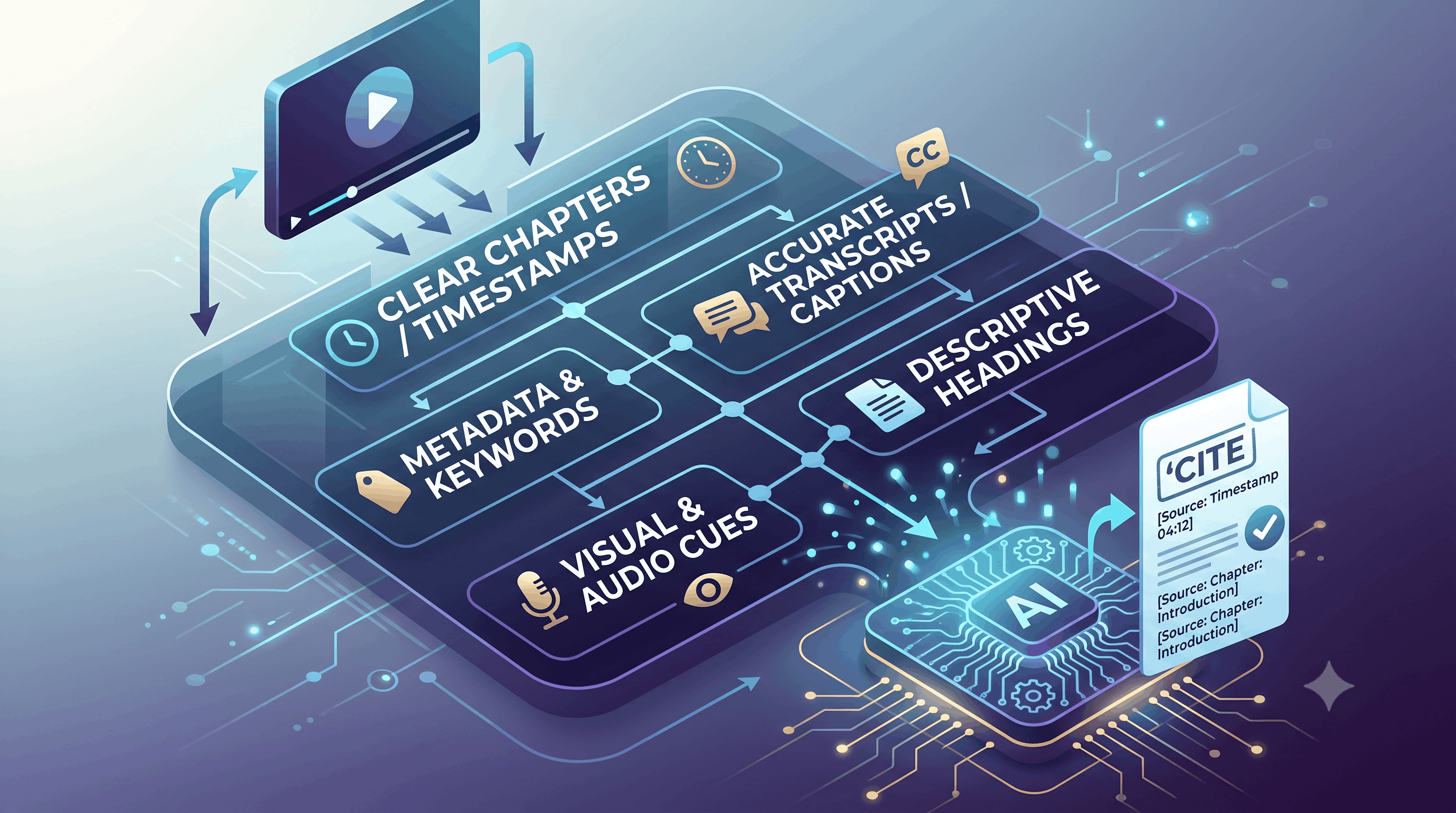
In our last Webinar, we covered the subject of Video for Visibility in the AI Age. This article breaks it down a bit more.
<p></p><p>Two companies shoot nearly identical explainer videos this month. One shows up as a cited source in AI Overviews for months afterward. The other sits at 4,000 views and gets pulled into zero AI answers, ever. What happened? </p><p>Google AI Overviews reached 65.07% of personalized U.S. search results as of March 2026, up from 60.32% in November 2025, according to Xponent21's tracking of an <a target="_blank" rel="noopener noreferrer nofollow" class="text-primary underline" href="https://xponent21.com/insights/google-ai-overviews-hit-65-the-tipping-point-we-predicted-is-here/">8,000-keyword Advanced Web Ranking dataset</a>. If you shoot video and want it to structure video content for AI citation instead of just racking up views, you need to know what AI systems actually read before you hit upload.</p><p><strong>The direct answer:</strong> to structure video content for AI citation, you need three things in place before or during upload: chapters that break the video into discrete, question-answerable segments (required past three minutes), an accurate transcript with complete metadata submitted alongside the video at the time of upload and a video type that matches your funnel stage, because AI weighs authorship and context as much as content. Skip any one of these and the video gets published without ever getting cited.</p><p>This article covers the tactical mechanics you can apply before your next shoot. If you've already accepted that video matters and want to know exactly what to do differently, keep reading.</p><h2>Why AI Can't Cite a Video it Can't Read</h2><p>AI systems don't watch your video. They read the audio transcription and the metadata submitted around it, then decide whether that text answers a question well enough to cite. A beautifully shot video with no transcript, no chapters and a generic description is, to an AI engine, mostly invisible.</p><p>The structured text wrapped around a video, the transcript, the chapters, the metadata, is the citable asset. That's a direct extension of <a target="_blank" rel="noopener noreferrer nofollow" class="text-primary underline" href="https://discoveraio.com/articles/citability-the-metric-that-replaces-rankings-in-ai-search">citability</a> as a metric. A page can rank without being citable if it doesn't answer a specific question cleanly, and a video works the same way. It can rack up views without ever getting pulled into an AI answer, because views measure attention and citation measures whether a machine can extract a clean answer from what you published.</p><p>On the backend, uploading a video means the platform ingests the file, the transcript (auto-generated or submitted), the title, the description, the chapter markers and any structured data attached to it. An AI engine crawling for an answer to "what does a Loom-style sales video look like" reads whatever text exists around your video and matches it against the question, working entirely from that text layer. If that text is thin, wrong or missing, the video doesn't surface, regardless of production quality.</p><p>That reframe changes what "finishing" a video means. Editing the footage is half the job. Structuring the text around it is the other half, and it's the half most marketers skip.</p><h2>Pick The Right Video for Your Funnel Stage Before You Shoot Anything</h2><img src="https://access.discoveraio.com/storage/v1/object/public/public-assets/email-images/AdobeStock_509217237.jpg" alt="" class="editor-image max-w-full h-auto rounded-lg cursor-pointer transition-all hover:opacity-80" draggable="false" style="max-width: 100%; height: auto;"><p>The video type you shoot should be a funnel-stage decision first and a creative decision second. Match the format to where your buyer is in their journey, then structure it for AI. Most guides on this topic treat every video as one undifferentiated "how-to" category. That's a mistake, because a founder story video and a Loom-style demo are trying to earn citations for completely different questions.</p><h3>Top of Funnel: Brand Story and Founder Videos</h3><p>Awareness-stage viewers don't know you yet. They need the "why we exist" and "who's behind this" videos: founder-on-camera pieces, team introductions, origin stories. These videos build the authorship signal that AI engines weigh when deciding whose content to trust.</p><p>Stock footage and scripted-actor videos work against you here. In our work with clients, LLMs consistently favor authorship signals, weighing who's speaking as part of evaluating a source, and a polished video with no identifiable human behind it reads as generic. A rougher video with a real founder talking directly to camera outperforms a slick video that could belong to any company in your category. Check out the insights of our parent company, Xponent21. </p><h3>Middle of Funnel: Explainer and FAQ Videos</h3><p>Consideration-stage buyers are comparing options and want specifics: what does this cost, how does the process work, what's it actually like to work with you. Two types of FAQ videos serve this stage. Process and product explainers cover the mechanics. FAQ videos handle the questions prospects are too early to ask a salesperson directly, things like pricing ranges or what the first 90 days look like.</p><p>This is also your strongest AEO opportunity in the funnel. A tightly chaptered FAQ video answering "what video should I make for consideration-stage buyers" or "what does your onboarding look like" gives an AI engine a clean, extractable answer tied to a specific, high-intent question.</p><h3>Bottom of Funnel: Personalized Loom-style and Testimonial Videos</h3><p>Decision-stage prospects are comparing quotes and want proof over more pitching. Screen-recorded, prospect-specific Loom videos and unscripted testimonial or review videos are the formats hardest to fake, which is exactly why they carry the most weight. A generic case study page can be written by anyone. A screen-recorded video walking a specific prospect through their specific numbers can't be replicated by a competitor, and a testimonial filmed by an actual customer in their kitchen or truck resonates louder than anything a brand says about itself.</p><p>These bottom-of-funnel formats are also the most resistant to being ignored by a prospect actively comparing two or three vendors. A quote sitting in an inbox is easy to skim past. A two-minute video with your name and their numbers on it holds attention far longer.</p><h2>The 4 Structural Elements AI Actually Reads</h2><img src="https://access.discoveraio.com/storage/v1/object/public/public-assets/email-images/AdobeStock_581567432.jpeg" alt="" class="editor-image max-w-full h-auto rounded-lg cursor-pointer transition-all hover:opacity-80" draggable="false" style="max-width: 100%; height: auto;"><p>Once you know what video to shoot, the structure around it determines whether AI can cite it. These four elements are the technical core of AEO for video, and skipping any one of them limits what an AI engine can extract.</p><h3>1. Hooks That Pose a Question</h3><p>Frame the opening seconds as a question. "What does it actually cost to switch providers" gives an AI engine a clean question-to-answer pairing it can extract and cite. A flat topic statement like "today we're talking about pricing" gives it nothing to pair. The hook holds viewer attention and gives an AI engine its first signal of what problem this video solves.</p><h3>2. Chapters: Required Past Three Minutes</h3><p>In our work with clients, any video over three minutes without chapters consistently underperforms on citations. Chapters let AI isolate and cite a specific segment instead of ignoring the whole video because the relevant answer is buried at the 6-minute mark with no marker pointing to it. Each chapter should map to a single question, so the engine can pull that one segment as a discrete, extractable answer rather than needing the full video for context.</p><h3>3. Transcription and Metadata</h3><p>AI pulls from the audio transcription and every piece of metadata you submit: title, description, tags, structured data where your platform supports it. A bad auto-caption is a bad source document as far as AI is concerned. If your transcript mangles your product name or garbles the answer to your most important question, that's the version of your video an AI engine is reading. Review and correct the transcript before publishing; don't assume the auto-generated version is close enough.</p><h3>4. Upload Sequencing: Structure it Before and During Upload</h3><p>This is the rule most marketers get backwards. Chapters, transcript and metadata need to be in place before or during upload. Treating that structure as a cleanup pass for later means your video sits unstructured, and uncited, for however long it takes you to circle back and fix it. Build the chapter list and write the description before you shoot, then finalize both the moment the edited video is ready to go live.</p><h2>Repurpose Your Video With Intent Instead of Rebuilding it For Every Platform</h2><p>You don't need a different video for every platform. You need one video's core message, repeated and cross-linked across an article, a LinkedIn post and the video itself, so AI recognizes all of it as pointing to a single, consistent source. This is the video-specific application of <a target="_blank" rel="noopener noreferrer nofollow" class="text-primary underline" href="https://discoveraio.com/articles/content-inception-from-the-inside">content inception</a>; for the full framework behind why this cross-format consistency matters, that article covers it in depth.</p><p>The mechanic is simple: take the core message from your video, write an article that covers the same ground and links back to the video, then post a LinkedIn update quoting one specific chapter with a timestamped link. Each piece points back to the others. That's what builds the ecosystem AI engines recognize as a single, coherent source, rather than three disconnected pieces of content that happen to share a topic. This has been a cornerstone of Discover AIO's content strategy since our launch in January of 2026, and is actually taught in our AI SEO Leadership Blueprint course. </p><p>Resist the urge to reshoot the same video in six aspect ratios and call it a repurposing strategy. One well-structured shoot, broken into chapters and referenced across formats, does more for citability than six thin variations of the same five minutes.</p><h2>A Worked Example: From One Shoot to a Citable Asset</h2><p>Picture this: A two-person marketing team at a regional home services company records one 12-minute founder-led video answering their five most common sales-call questions: pricing ranges, timeline, what happens if something goes wrong, whether they're licensed and insured and what the first appointment looks like.</p><p>Before uploading, they chapter the video by question, five chapters, five direct answers, and write a full description covering the same five questions with the founder's name and the company's service area. They submit all of it at the moment of upload. Then they write a short article covering the same five questions, linking it to the video, and post a LinkedIn update quoting the "what happens if something goes wrong" chapter with a timestamped link back to that exact moment.</p><p>Three weeks later, the video, the article and the LinkedIn post all reference each other and answer the same five questions in slightly different formats. Someone asking an AI engine "what happens if a job goes wrong" in this company's service area now has three consistent, cross-linked sources pointing to the same answer, instead of one video sitting alone with no structure and no context around it.</p><p>This mirrors what we've seen play out with at least one agency client: FAQ-style video content, structured properly at the point of publishing, kept surfacing as a cited source for those exact questions years later. The structure, done once and done correctly, keeps paying off long after the shoot.</p><h2>Keep the Human on Camera: The Ethical AI Line In The Sand</h2><p>AI is the tool that transcribes your audio, structures your metadata and helps you repurpose one shoot into multiple assets. It does not replace the person on camera, and it shouldn't try to.</p><p>Using an AI-generated avatar or a synthetic voiceover to fake authenticity undercuts the exact signal this article just walked you through building. In our work with clients, LLMs consistently favor authorship signals when deciding whether to trust and cite a source. A synthetic presenter has no verifiable authorship behind it, which means you'd be optimizing the structure around a video while sabotaging the credibility signal that structure is supposed to reinforce.</p><p>A solo agency owner who's nervous about being on camera records a rough, unscripted Loom walkthrough for a single prospect instead of investing in a polished, stock-footage-driven brand video. The Loom wins on authenticity even though it has none of the production value: real voice, real screen, real answers to that prospect's actual questions, which is exactly the signal AI weighs when deciding what to trust. Use AI to handle the transcription, the chapter markers and the repurposing workflow. Keep the person answering the question human.</p><h2>Key Takeaways</h2><ul><li><p>AI systems cite the structured text wrapped around a video: the transcript, the chapters and the metadata.</p></li><li><p>Which video to make is a funnel-stage decision: brand or founder videos for awareness, explainer and FAQ videos for consideration, Loom-style and testimonial videos for decision.</p></li><li><p>Past three minutes, chapters become a citation requirement, because each one gives AI a discrete, extractable answer to cite.</p></li><li><p>Structure your transcript, chapters and metadata before or during upload, as part of the production process itself.</p></li><li><p>Repurpose one well-structured shoot across formats with intent instead of reshooting for every platform.</p></li><li><p>Keep a real, identifiable human on camera. Authorship is a signal AI weighs directly, and synthetic presenters undercut it.</p></li></ul><h2>Frequently Asked Questions</h2><img src="https://access.discoveraio.com/storage/v1/object/public/public-assets/email-images/AdobeStock_293471314.jpeg" alt="" class="editor-image max-w-full h-auto rounded-lg cursor-pointer transition-all hover:opacity-80" draggable="false" style="max-width: 100%; height: auto;"><h3>How does AI actually read video content?</h3><p>AI engines don't process video footage directly. They read the audio transcription and the metadata submitted with the video, including the title, description, tags and chapter markers, then match that text against a user's question. A video with an accurate transcript and clear chapters gives an AI engine a clean passage to extract and cite.</p><h3>Do I need chapters on every video?</h3><p>Any video over three minutes should have chapters. Chapters let AI isolate and cite a specific segment of your video instead of needing to process the entire piece to find one answer. For videos under three minutes, a strong hook and accurate transcript matter more than chapter breaks.</p><h3>What video type should I make first for AI search?</h3><p>Start with whichever funnel stage has the biggest gap in your current content. If you have no founder-facing content, start with a brand or founder story video for awareness. If prospects consistently ask the same questions before buying, an FAQ or explainer video for consideration will earn citations faster because it maps directly to specific, high-intent questions.</p><h3>Does the order I upload transcript and metadata matter?</h3><p>Yes. Structure your chapters, transcript and metadata before or during upload rather than adding them afterward. A video published without this structure sits uncited until you go back and fix it, and that gap is time your competitors can use to get their structured version indexed first.</p><h3>Do I need a different video for every platform?</h3><p>No. Shoot one well-structured video around a core message, then repurpose it with intent: an article covering the same questions, a LinkedIn post quoting a specific chapter and links back to the original video. Reshooting thin variations of the same content for every platform dilutes the consistency that helps AI recognize your content as a single, coherent source.</p><h2>Where To Go From Here</h2><img src="https://access.discoveraio.com/storage/v1/object/public/public-assets/email-images/Where_to_go_from_here__1_.jpg" alt="" class="editor-image max-w-full h-auto rounded-lg cursor-pointer transition-all hover:opacity-80" draggable="false" style="max-width: 100%; height: auto;"><ul><li><p>For the underlying metric this article builds on, <a target="_blank" rel="noopener noreferrer nofollow" class="text-primary underline" href="https://discoveraio.com/articles/citability-the-metric-that-replaces-rankings-in-ai-search">Citability: The Metric That Replaces Rankings in AI Search</a> explains why citation is the number worth tracking.</p></li><li><p>For the full cross-format framework this article applies narrowly to video, <a target="_blank" rel="noopener noreferrer nofollow" class="text-primary underline" href="https://discoveraio.com/articles/content-inception-from-the-inside">Content Inception, From the Inside</a> covers the complete model.</p></li><li><p>If you're still deciding which formats deserve your limited production time beyond video, <a target="_blank" rel="noopener noreferrer nofollow" class="text-primary underline" href="https://discoveraio.com/articles/5-ways-to-expand-beyond-pages-into-formats-ai-can-learn-from">5 Ways to Expand Beyond Pages Into Formats AI Can Learn From</a> is the sibling piece on format diversification.</p></li><li><p>For the deeper framework behind why AI evaluates sources the way it does, <a target="_blank" rel="noopener noreferrer nofollow" class="text-primary underline" href="https://discoveraio.com/guides/the-complete-guide-to-ai-eligible-citation">The Complete Guide to AI-eligible Citation</a> walks through the Authority Stack and a 30-day implementation plan.</p></li></ul><p>Match your next video to its funnel stage, chapter it past three minutes, transcribe it accurately and submit the metadata at upload. That workflow change is the difference between a video that gets watched once and one that keeps earning citations months later. If you want the community that's already testing this in real time and sharing what's actually getting cited, <a target="_blank" rel="noopener noreferrer nofollow" class="text-primary underline" href="https://discoveraio.com/membership">DiscoverAIO membership</a> is built for exactly that. If you'd rather find someone who already does this kind of video production work, the Discover AIO Member Directory is the place to start. And check out the full webinar that spawned this article <a target="_blank" rel="noopener noreferrer nofollow" class="text-primary underline" href="https://youtu.be/67Rymo7BeKk?si=nGzDv4po4aOJfz7C">here</a>. </p>