How to Learn AI SEO: The Roadmap Marketers Are Actually Using in 2026
By Garry M. Callis Jr.
Here at Discover AIO, we talk a lot about AI SEO, heck it's the reason we're here. But we may not have done the best in explaining the WHY behind what we do, and why we do it.
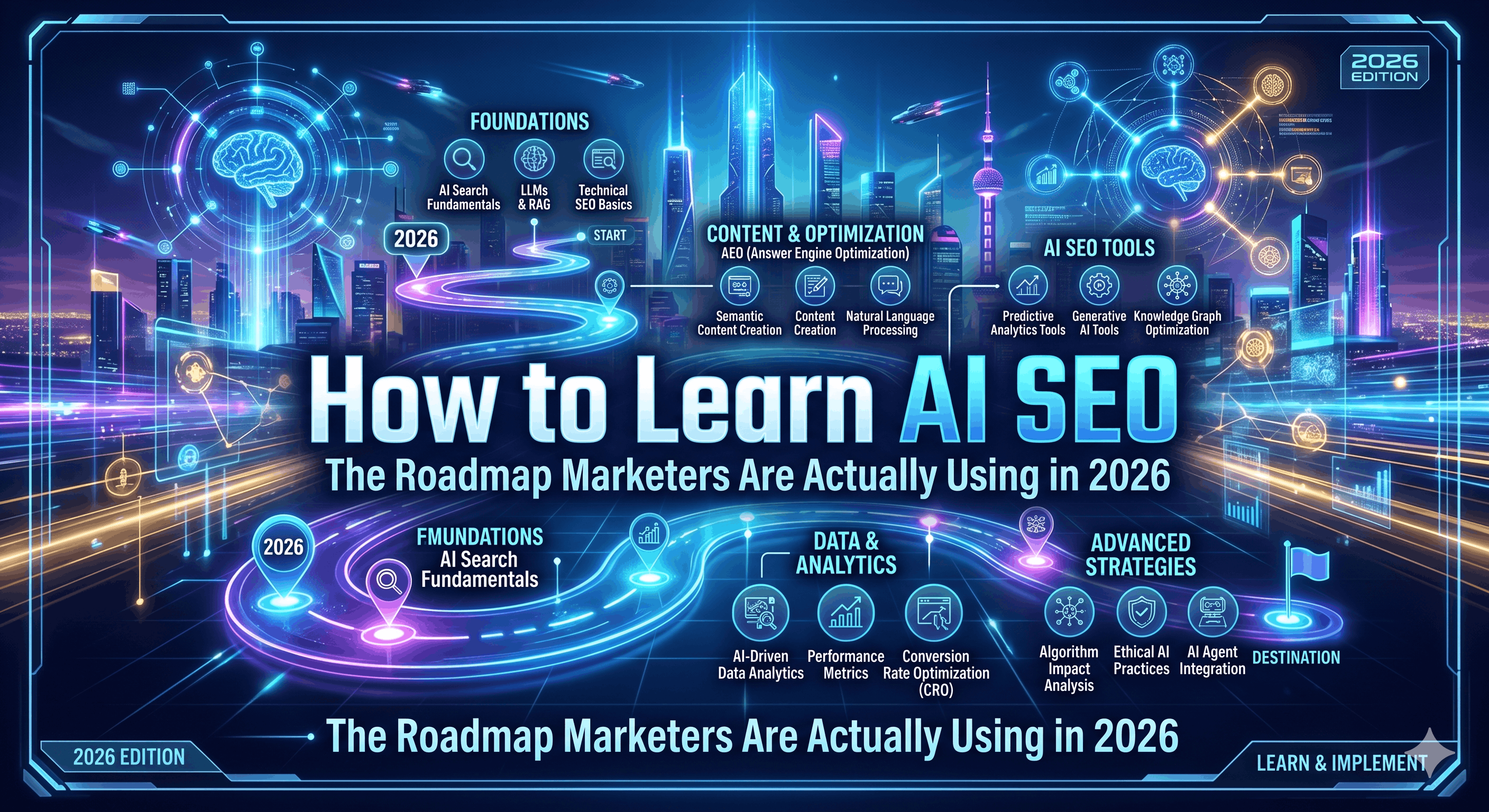
<p>You have been doing SEO long enough to recognize when a shift is real.</p><p></p><p>Rankings you held for years are getting replaced by AI-generated answer boxes. Traffic that used to convert is going dark. Clients are asking questions you don't have clean answers to yet. And every resource you find about "learning AI SEO" either assumes you're starting from zero or just lists tools to try.</p><p>Neither is what you need.</p><p>You don't need to start over. You need a full-blown upgrade. We’ve talked about AI SEO extensively on this platform, but may not have done the best job of explaining what AI SEO really is. So let’s answer the question, “what <em>is </em>AI SEO?”</p><p>AI SEO is the practice of optimizing content so that AI-powered search engines and answer engines surface, synthesize, and cite it accurately. It builds directly on traditional SEO foundations, keyword research, content quality, site authority, and layers on a new set of requirements around how AI engines evaluate structure, trustworthiness, and answer quality.</p><p>The marketers developing AI SEO skills fastest aren't the ones abandoning what they know. These guys are pivoting to answer a completely new set of questions in a field whose rules are changing every single day. </p><h2><br><strong>WHAT AI SEO REQUIRES THAT TRADITIONAL SEO DOESN'T</strong></h2><p></p><p>Traditional SEO is built around signals: keywords, backlinks, page authority, technical health. You optimize content to match what a crawler reads and what an algorithm weighs.</p><p>AI SEO adds a different question to every piece of content you produce: Can an AI engine extract a clean, direct, trustworthy answer from this?</p><p>That's not a keyword question. In actuality, it questions the fundamentals you thought were once true. This is a paradigm shift in how marketing works. </p><p></p><h3><strong>From Rankings to Citability</strong></h3><p></p><p>In traditional SEO, success is a blue link on page 1 of a search results page. In AI SEO, success is your content being synthesized into an AI-generated answer, a Google AI Overview, a Perplexity citation, a ChatGPT response that names your brand as the source. When you think about it, as a marketer, you’d want those queries to name you as the answer, the source of truth for their pain points. </p><p>Getting cited requires what practitioners now call AI citability: a combination of structured formatting, direct definitions, demonstrated topical depth, and entity signals that make an AI engine confident enough to quote you. A technically optimized article that buries its main point in the fourth section will not earn that citation, regardless of its ranking position.</p><p>A content manager at a B2B SaaS company watched her best-performing article drop out of the rankings and get replaced by a Google AI Overview from a competitor. She had years of solid SEO fundamentals but no framework for what had happened or why. Learning the basics of AI citability gave her a specific diagnostic and a fix list she could act on within two days.</p><p><br></p><h3><strong>How E-E-A-T Changed Meaning</strong></h3><p><br></p><p>Google's E-E-A-T framework has always shaped quality signals. AI engines apply it with more precision. When a generative AI is producing an answer that thousands of people will read without clicking through to verify, it is conservative about what it cites. It favors content with named authors, demonstrated credentials, consistent topical presence, and verifiable sources. Bear in mind that <a target="_blank" rel="noopener noreferrer nofollow" class="text-primary underline" href="https://ahrefs.com/blog/ai-overviews-reduce-clicks-update/"><u>AI Overviews reduce clicks by 58 percent. </u></a> Meaning that when someone types in a query, that question is immediately answered for them without any work. <a target="_blank" rel="noopener noreferrer nofollow" class="text-primary underline" href="https://discoveraio.com/author/admin-author"><u>Will Melton</u></a>, CEO of Xponent 21, put it this way. “We are no longer in the age of Search Engines, we’re in the age of Answer Engines.” In short, you want to ensure that when someone looks up something in your niche, you’re the source of truth for them. <br><br><br></p><p>For marketers, the practical implication is this: anonymous content now has a structural disadvantage. Your byline, author bio, and consistent publishing presence on a specific topic cluster are ranking signals in ways they weren't three years ago.</p><p><br></p><h4><strong>THE AI SEO SKILL STACK: WHAT TO LEARN, IN WHAT ORDER</strong></h4><img src="https://access.discoveraio.com/storage/v1/object/public/public-assets/email-images/Gemini_Generated_Image_feixhpfeixhpfeix__1_.png" alt="" class="editor-image max-w-full h-auto rounded-lg cursor-pointer transition-all hover:opacity-80" draggable="false" style="max-width: 100%; height: auto;"><p><br></p><p>Not all AI SEO skills carry equal weight. Some are foundational. Some are high-value additions. Some are specialist territory. Build them in this order.</p><h3>Tier 1: Non-Negotiables</h3><p><strong>Generative Engine Optimization (GEO):</strong> Understanding how AI search engines decide what content to synthesize and surface. This covers which content structures earn citations, how AI systems handle conflicting information across sources, and what "topical authority" means to a language model rather than a keyword crawler. GEO is the conceptual foundation everything else builds on.</p><p></p><p><strong>Answer Engine Optimization (AEO): </strong>Structuring content so it answers specific questions in a clean, extractable format. This means writing definition blocks that stand alone, using FAQ-formatted headings, and placing direct answers in the first 200 words of an article, not buried in section four. AEO is where theory becomes practice fastest.</p><p></p><p><strong>Structured content clusters:</strong> Building groups of interconnected articles that collectively establish topical authority, rather than isolated posts that cannibalize each other. A single strong article is a roll of the citation dice. Ten well-structured, interlinked articles on a defined topic cluster is an authority signal that compounds. AI engines use that cluster depth to decide which brands they treat as trusted sources. You’ll find that even on Discover AIO, we write about things that tie into one another, forming a content cluster/ecosystem that feeds into itself. </p><p><br></p><h3>Tier 2: High-Value Additions</h3><p></p><p><strong>Schema markup</strong>: Specifically Article, FAQ, and HowTo schema. Schema doesn't guarantee AI citations, but it increases the confidence an AI engine has that your content is what it claims to be. FAQ schema on a well-structured FAQ page is one of the highest-yield technical implementations available right now, relatively low effort, measurable impact on AI Overview placement.</p><p></p><p><strong>Entity optimization:</strong> Making sure AI engines know who you are, what you cover, and how your brand connects to its topic area. Author bios with specific credentials, about pages with clear positioning, brand mentions across authoritative sources, and consistent topical presence all feed into this. Think of it as building a dossier that AI engines can reference to verify you are who you say you are.</p><p></p><p><strong>AI citation tracking:</strong> Monitoring whether your content is being cited in AI-generated answers. Tools like <a target="_blank" rel="noopener noreferrer nofollow" class="text-primary underline" href="http://Otterly.ai"><u>Otterly.ai</u></a><a target="_blank" rel="noopener noreferrer nofollow" class="text-primary underline" href="http://otterly.ai"><u> </u></a>and <a target="_blank" rel="noopener noreferrer nofollow" class="text-primary underline" href="http://olympuslab.uk"><u>Olympus Lab</u></a>, a new DiscoverAIO community partner, let you track brand and content mentions across AI answer surfaces. Without tracking, you're optimizing blind. As the old saying goes, “Those who work without knowledge, work uselessly.”</p><h3>Tier 3: Specialist Skills</h3><p></p><p><strong>LLM-specific content evaluation:</strong> Understanding how large language models assess content quality and what that means for how you write at the sentence and paragraph level. This is more advanced territory, but it informs decisions about depth, source quality, and the ratio of assertion to evidence in your writing.</p><p></p><p><strong>AI search analytics: </strong>Building reporting frameworks that capture AI-driven traffic separately from organic, attributing conversions to AI citation surfaces, and measuring citation frequency as a performance indicator alongside traditional rank tracking. This is the reporting layer that turns AI SEO work into a business case study waiting to happen. </p><p><br></p><h2><strong>HOW TO LEARN AI SEO: A PRACTICAL SEQUENCE</strong></h2><img src="https://access.discoveraio.com/storage/v1/object/public/public-assets/email-images/Gemini_Generated_Image_d5irs5d5irs5d5ir__1_.png" alt="" class="editor-image max-w-full h-auto rounded-lg cursor-pointer transition-all hover:opacity-80" draggable="false" style="max-width: 100%; height: auto;"><p><br></p><h4><strong>Start With How AI Engines Work</strong></h4><p>Before you optimize for AI search, understand what you're optimizing for. Not at an engineering level. At a functional level: how does a search engine decide what content to put in an AI Overview? What makes a generative model confident enough to cite a source over the dozens of other sources covering the same topic?</p><p></p><p>Read primary sources, Google's documentation on AI Overviews, Perplexity's published thinking on how it sources responses, alongside practitioner commentary from people running real experiments. Theory without application produces slow, brittle learning. Be willing to pressure test your theories. LLMs are very good at running simulations, so give a practical example, and work through it. </p><h4><strong>Audit Before You Create</strong></h4><p></p><p>The fastest way to build AI SEO instincts is to apply them to content that already exists. Take your current best-performing page and run it through an AEO lens. Is the main question answered in the first 200 words? Is the heading structure clean and logical? Are there standalone sentences an AI engine can quote without needing three paragraphs of surrounding context?</p><p>This audit builds pattern recognition. You start seeing the gap between "content that ranks" and "content that gets cited" in concrete, specific terms.</p><p>A freelance SEO consultant applied this process to one client's FAQ page. She restructured the answers into clean definition blocks, added FAQ schema, and made each answer function independently. Within six weeks, that page earned AI Overview citations for three queries the client had never explicitly targeted. She now leads with AEO optimization as a core service.</p><h4><strong>Learn in Community</strong></h4><p></p><p>AI SEO is moving fast enough that no course or guide stays fully current without community context. The practitioners developing skills fastest are the ones learning from each other, sharing experiments, comparing results, finding out what actually worked on a live site in the last thirty days.</p><p>This is the model DiscoverAIO is built on. Structured learning through courses and guides, combined with peer learning through community discussion, member calls, and a <a target="_blank" rel="noopener noreferrer nofollow" class="text-primary underline" href="https://discoveraio.com/directory"><u>Member Directory</u></a> of active AI SEO practitioners. What a course teaches in week one, a community stress-tests and refines in the weeks after you deploy it. We have a couple of folks who have already written articles for us here on the platform, why not you too? </p><p><br></p><h2><strong>WHAT TO LOOK FOR IN AN AI SEO COURSE</strong></h2><p></p><p>Not all AI SEO training is worth your time. These are the signals worth checking before you commit:</p><ol><li><p>Practitioner-led, not synthesized. The instructor should be running live experiments on real sites, not aggregating and repackaging other people's research.</p></li><li><p>Distinguishes between GEO, AEO, and traditional SEO. Anyone who treats these as interchangeable hasn't worked deeply in the space.</p></li><li><p> Frameworks you can deploy immediately. Not concepts to understand eventually.</p></li><li><p>Current. The AI search landscape shifted significantly through 2024 and 2025. A course written before those shifts has real gaps.</p></li></ol><p><a target="_blank" rel="noopener noreferrer nofollow" class="text-primary underline" href="https://discoveraio.com/courses/ai-seo-leadership-blueprint-command-rankings-drive-success"><u>DiscoverAIO's AI SEO Leadership Blueprint</u></a> is built for everyone. From beginners who have never heard of AI SEO, to experienced marketers who want the upgrade layer, not a restart. It covers GEO and AEO principles, topical authority architecture, structured content strategy, and performance measurement. This course gives a very strong foundation to those who are serious about learning about this kind of work. </p><p></p><h3><strong>HOW LONG DOES IT TAKE TO LEARN AI SEO?</strong></h3><p></p><p>Here’s what we’re not going to do. We are not going to type out some two-bit hokey promise that you’re going to immediately learn AI SEO and be a master at it from Day 1. That’s unrealistic. However, what we will say is that with consistent training, practical application, and a shift in mindset, you can expect these concepts to take hold sooner than you may think. Personally, when I started at Xponent21, I had ZERO knowledge of AI SEO. I took the AI SEO Leadership Blueprint course, and started applying my knowledge to things I already knew, and it started to click. In a couple of months, I was given actual client work, working on blog optimizations, and within a month, I helped get this client cited in AI search results. Check out the <a target="_blank" rel="noopener noreferrer nofollow" class="text-primary underline" href="https://xponent21.com/insights/case-study/pool-brokers-usa-strategic-seo-case-study/"><u>work we did for Pool Brokers USA</u></a>. </p><p></p><p>The marketers building these skills fastest share one habit: they deploy from week one. Even small experiments. Apply the knowledge you’re gaining into fields and points of interest you already have. </p><p>An agency owner spent six months consuming AI SEO content and ended up with a list of tools he never applied systematically. Nothing improved for his clients. The problem wasn't the resources, it was that he treated AI SEO as something to understand before doing, rather than something to do in order to understand.</p><p>The curve is real. It's shorter than most people expect once you stop treating AI SEO as a separate discipline and start treating it as the next layer of what you've already built. Go to Reddit, these questions are being asked already about how AI is systematically changing how SEO works. Get into the conversation and give your insights. </p><p><br><br></p><h4><strong>START WHERE YOU ARE RIGHT NOW</strong></h4><p></p><p>The shift to AI SEO does not require abandoning your expertise. It requires pointing that expertise at a new set of questions: How does this content answer a specific question? How does it demonstrate authority to an AI engine? How does it fit into a cluster that builds topical depth?</p><p>If you've been doing SEO for years, you already have the foundation. The upgrade layer is learnable. You don't have to figure it out alone. We’re here to help you along the way. The examples given in this article may be fictitious, but the use cases are as real as it gets. </p><p><br>Join<a target="_blank" rel="noopener noreferrer nofollow" class="text-primary underline" href="https://discoveraio.com/signup"><u> DiscoverAIO</u></a> to access the AI SEO Leadership Blueprint, connect with practitioners running experiments right now, and build the skills that AI search actually rewards. We have a Community Call every 2nd Wednesday of every month. Our next one will be on May 13th, 2026 at 2pm EST. Join us, register for the event, and hang out with us.</p>