AI Search Visibility For Restaurants: Why 83% Are Invisible (And How To Fix It)
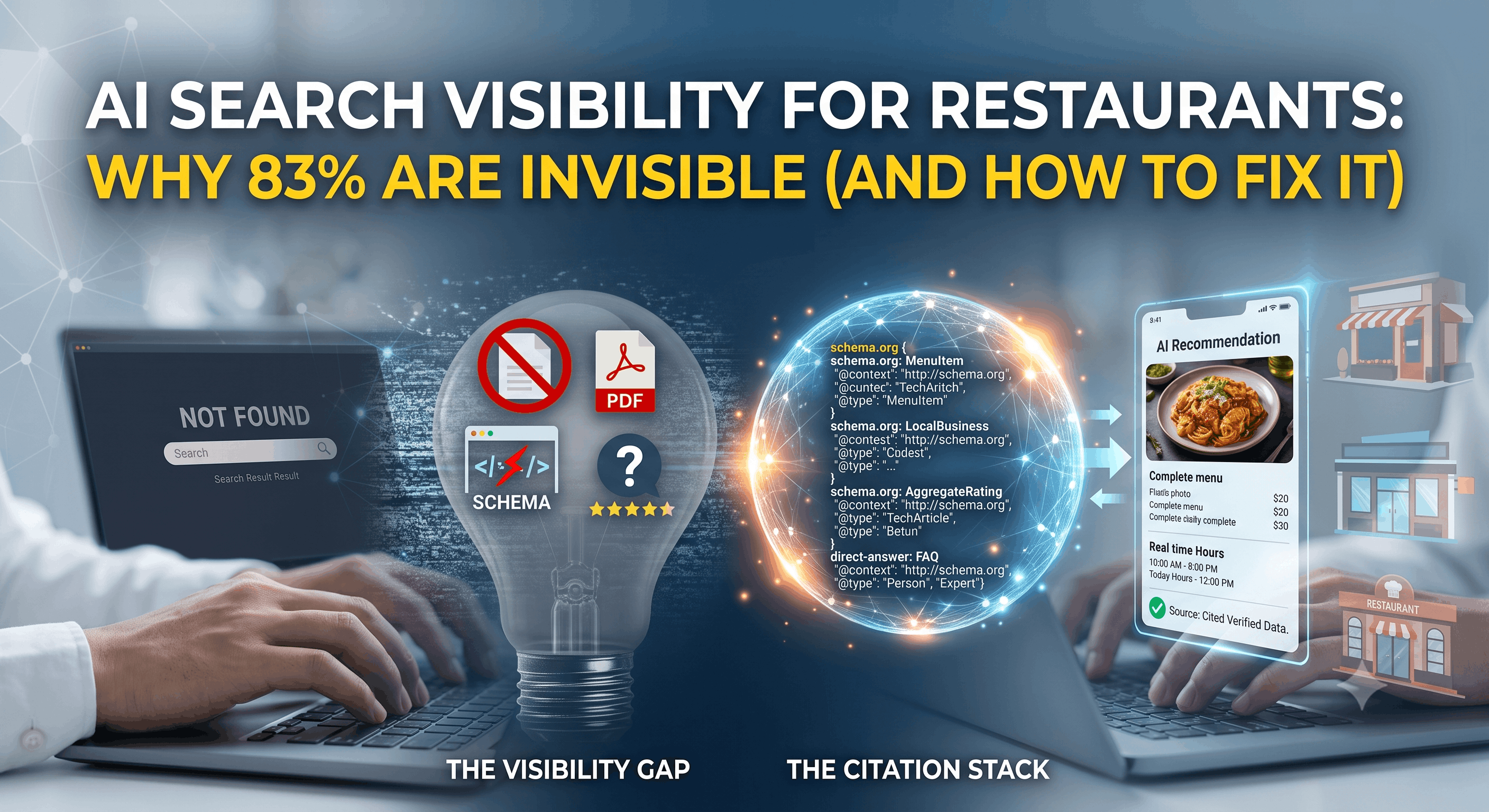
Restaurants are in a constant arms race for attention. Especially when you consider a lot of these concept/boutique eateries which specialize in specific items. In this article, we discuss how to stand out across different platforms.
<p>A regional pizza chain you manage ranks first in the local map pack for every market it operates in. Its owner mentions, almost in passing, that a customer told them ChatGPT recommended a competitor instead. You assume it's a fluke. It isn't. You then decide to run a search, not just with ChatGPT but across the mainstream LLM landscape. The results are conclusive, your competitor is appearing higher than your pizza chain restaurant across multiple queries. It's not time to panic, it's time to get strategic. We're here to help.</p><p><br><br></p><p>AI search visibility for restaurants is worse than most marketers realize: 83% of restaurant locations are invisible in AI-generated dining recommendations, according to <a target="_blank" rel="noopener noreferrer nofollow" class="text-primary underline" href="https://natlawreview.com/press-releases/83-restaurants-are-invisible-ai-search-new-uberall-report-reveals-discovery"><u>Uberall's "Fast Food, Faster Discovery: The 2026 GEO Playbook for Multi-Location QSRs,"</u></a> published May 7, 2026. Only 17% of restaurants appear when a consumer asks ChatGPT, Gemini, Perplexity, Copilot, or Google AI Overview for a nearby option, and the gap has nothing to do with whether these businesses show up online in the first place. 86% of the invisible 83% maintain an active Google presence, with claimed listings, current hours, and photos. </p><p>Think about that for a second. You could have a restaurant with amazing food, amazing vibes, but because of a lack of presence in AI, no one knows who you are. But yet, these massive restaurants with massive budgets can pay to get their marketing teams to get all the content necessary to be visible. That's a discrepancy that shouldn't exist now that AI is in the picture.</p><p></p><h2><strong>AI Search Visibility For Restaurants: The Discovery Gap No One's Watching</strong></h2><h2></h2><p>83% of restaurant locations don't appear when someone asks an AI assistant for a dining recommendation, and <a target="_blank" rel="noopener noreferrer nofollow" class="text-primary underline" href="https://natlawreview.com/press-releases/83-restaurants-are-invisible-ai-search-new-uberall-report-reveals-discovery"><u>86% of those invisible restaurants have already done the traditional local SEO work</u></a>: a claimed Google Business Profile, current hours, and real photos.</p><p>That gap is the whole story for this article. A restaurant can rank well, look complete on every listing, and still lose the recommendation the moment a customer asks an AI assistant instead of scrolling a results page. For agencies and in-house marketers managing restaurant clients, this is the visibility channel almost nobody is actively auditing right now, even though a growing share of dining decisions start there.</p><p></p><p>Picture this: a 6-location seafood restaurant group has every location's Google Business Profile fully claimed, verified, and updated with current hours and fresh photos every month. The group's average rating sits at 4.6 across all locations, and traditional Google search puts at least one location in the map pack for every relevant search in its market. When the agency runs the group's actual target queries through ChatGPT and Perplexity as part of a routine audit, none of the six locations get named for a single query. Every traditional local SEO signal was strong, and none of it mattered to the system actually deciding who gets recommended.</p><p><br><br></p><h2><strong>Why Traditional Local SEO Isn't Enough For AI Recommendations</strong></h2><img src="https://access.discoveraio.com/storage/v1/object/public/public-assets/email-images/Local_3_Pack.png" alt="" class="editor-image max-w-full h-auto rounded-lg cursor-pointer transition-all hover:opacity-80" draggable="false" style="max-width: 100%; height: auto;"><p></p><p>Ranking well in Google's local 3 pack and appearing in an AI assistant's dining recommendation are two different outcomes, produced by two different systems with the same intent.</p><p></p><p>Traditional search returns a ranked list a searcher scrolls through, so a business at position four still gets seen. AI search returns a short, synthesized answer naming a handful of options, and a business left out of that answer simply never enters the conversation. <a target="_blank" rel="noopener noreferrer nofollow" class="text-primary underline" href="https://discoveraio.com/articles/local-seo-isnt-dead-your-strategy-is-outdated"><u>Local SEO isn't dead, but the strategy built for a scrollable results page doesn't automatically transfer to a system built to name three names and stop.</u></a></p><p></p><p>That difference explains how a restaurant with strong map pack rankings can still be part of the 83%. The signals that earn a position four map pack ranking, like proximity and category match, differ from the signals an AI engine weighs when deciding which three or four restaurants to name out loud.<br></p><p>Picture this: Two barbecue restaurants sit two miles apart in the same city. Restaurant A holds the top map pack position for "barbecue near me" and has for over a year. Restaurant B sits at map pack position six for the same search, but its owner has spent the last quarter making sure every platform lists identical hours, responding personally to every review within 48 hours, and keeping its rating above 4.5. When a customer asks ChatGPT for a barbecue recommendation in the same city, Restaurant B is the one that gets named. Restaurant A never comes up.</p><p></p><p>Ranking high on Google doesn't guarantee inclusion in an AI Overview, and showing up in an AI Overview doesn't guarantee ChatGPT ranks you the same way. It's a double-edged sword, three separate systems, three separate ways to end up invisible. We covered this exact tension on a recent webinar, using fintech and medical practices as the examples.</p><p></p><h2><strong>What AI Engines Actually Check Before Recommending A Restaurant</strong></h2><p></p><p>AI engines weigh a restaurant's rating, review recency, and cross-platform listing consistency before naming it in a dining recommendation, and Uberall's benchmark data shows these thresholds vary by platform.</p><p></p><h3><strong>Rating Thresholds By Platform</strong></h3><p></p><p><a target="_blank" rel="noopener noreferrer nofollow" class="text-primary underline" href="https://natlawreview.com/press-releases/83-restaurants-are-invisible-ai-search-new-uberall-report-reveals-discovery"><u>Uberall's May 2026 report</u></a> found ChatGPT's recommendations skew toward restaurants averaging 4.3 stars or higher, Perplexity's observed floor sits closer to 4.1, and Gemini includes venues down to roughly 3.9. These are benchmark patterns observed in Uberall's data rather than confirmed algorithmic cutoffs the platforms have published, so treat them as directional guidance for where a client's rating needs to sit rather than a hard pass or fail line.</p><p></p><p>I'd rather see the same numbers show up across five or six different vendor reports before I trust them, and even then I take it with a grain of salt. You never know if someone ran the study and then positioned themselves as the top result in it.</p><p></p><h3><strong>Review Recency And Volume</strong><br></h3><p>A high average rating built on reviews from three years ago carries less weight than a lower average built on reviews from the past month. The same recency-over-volume pattern shows up across other verticals this site has covered, and it's a reasonable working assumption here even without a restaurant-specific study confirming the exact mechanism: an active, recent review flow signals a currently-operating business in a way a static, aging rating count does not.</p><p></p><h3><strong>Listing Consistency</strong></h3><p></p><p><strong>Restaurant AI search optimization</strong> depends heavily on whether a restaurant's name, address, hours, and menu details match across every platform an AI engine might pull from. A phone number that's correct on Google but outdated on Yelp is exactly the kind of inconsistency that makes a system hedge and recommend a cleaner-listed competitor instead. This is going to be a recurring theme across all of our vertical articles. NAP (name, address, phone number) is what ties everything together. Across your Google Business Profile, if your NAP isn't consistent, AI and people alike are going to have a hard time mentioning you consistently. <br></p><h2><strong>The Market-Concentration Problem: Why AI Recommends The Same Few Names</strong></h2><p><br></p><p>AI dining recommendations concentrate heavily around a small number of names per category, which changes what a realistic goal looks like for an independent or small-chain restaurant client.<br></p><p><a target="_blank" rel="noopener noreferrer nofollow" class="text-primary underline" href="https://natlawreview.com/press-releases/83-restaurants-are-invisible-ai-search-new-uberall-report-reveals-discovery"><u>Uberall's data</u></a> found the top three brands in a given restaurant category capture 53.4% of total AI "share of voice," and AI assistants typically name only three to five restaurants per query rather than presenting a longer list. For a client competing against an established regional or national chain, the honest goal for month one is consistent inclusion among the small number of names an AI engine reliably surfaces, well short of outranking the category leader outright.</p><p>I haven't personally seen this exact pattern with a restaurant client, but I've seen it plenty with other types of clients: agencies pitching AI visibility like it's a guaranteed win. There's no reason that same pattern wouldn't show up with restaurant clients too, and the concentration data above is the reality check that pitch eventually runs into.</p><p><br><br>Picture this: instead of promising the client will out-rank the two established chains dominating "best Italian near me" queries in their metro, the agency sets the actual target: consistently appear as one of the three to five names an AI engine surfaces, and treat that as the win worth reporting on, rather than chasing a category-leader position that the market concentration data makes unrealistic in month one.<br></p><h2><strong>A Practical Starting Checklist For Restaurant Clients</strong></h2><img src="https://access.discoveraio.com/storage/v1/object/public/public-assets/email-images/AdobeStock_308213175.jpg" alt="" class="editor-image max-w-full h-auto rounded-lg cursor-pointer transition-all hover:opacity-80" draggable="false" style="max-width: 100%; height: auto;"><p></p><p>Before building new content or running paid campaigns, audit a restaurant client's existing AI visibility signals against what Uberall's data shows AI engines actually check. <a target="_blank" rel="noopener noreferrer nofollow" class="text-primary underline" href="https://discoveraio.com/articles/why-home-service-companies-are-losing-calls-to-ai-search"><u>The same audit-before-content approach applies to home service businesses facing this exact gap.</u></a><br></p><ul><li><p>Pull the client's current rating on every platform an AI engine might reference, and compare it against the 4.3 / 4.1 / 3.9 benchmark range by platform</p></li><li><p>Check whether the client has a consistent, active review-request flow, or whether recent reviews have gone stale</p></li><li><p>Cross-check name, address, phone number, and hours across Google, Yelp, and any delivery platforms the client uses</p></li><li><p>Confirm the client's site or listings answer the practical questions a diner would ask an AI assistant: dietary options, reservation policy, parking</p></li><li><p>Run the client's actual target queries, like "best [cuisine] in [city]," across ChatGPT, Perplexity, and Google AI Overview to see who currently gets named</p></li></ul><p></p><p>Getting your restaurant recommended by ChatGPT starts with this audit rather than a cookie-cutter content calendar. Fixing a rating gap or a listing inconsistency moves the needle faster than publishing new pages a system has no reason to trust yet<br></p><h2><strong>How To Track Your Restaurant's AI Search Visibility</strong></h2><p></p><p>Run the same target queries across the major AI engines every month, log whether the client appears, how the engine describes them, and which competitors get named instead.<br></p><p>Picture this: a marketing consultant managing a 12-location regional pizza chain runs "pizza near me" and "best pizza delivery in [city]" across ChatGPT, Perplexity, and Gemini on the first of each month. She finds the chain's average rating sits at 4.1, just under ChatGPT's apparent preference, with reviews that haven't been actively managed in eight months. She starts a review-request cadence at every location and fixes three outdated phone numbers across delivery platform listings, then tracks the same queries monthly to see whether the chain starts appearing in ChatGPT's answers specifically, since that was the platform where the rating gap looked most likely to matter.</p><p><br></p><p>If you think about it, ranking in AI Overviews for a restaurant works the same way any measurement discipline does: without a monthly check against real target queries, a marketer has no way to know whether a rating fix or a listing cleanup actually changed anything. <a target="_blank" rel="noopener noreferrer nofollow" class="text-primary underline" href="https://discoveraio.com/articles/how-to-measure-your-visibility-in-ai-search"><u>The same tracking discipline applies broadly across AI search, across every vertical Discover AIO covers.</u></a></p><p>So again, think about the queries you want your establishment to rank for, and create content specifically for the niche you want to be in. If you're a pizza chain, and you specialize in Detroit-style pizza, then make the best Detroit-style pizza you can, get as many foodies talking about your pizza as you can, get reviews and testimonials up, blogs, all that good stuff. If you do all of this consistently, you will rank. It's that simple. Same if you specialized in Chicago-deep dish, Brooklyn style, or any other pizza variety. These are niches, niches are their own long-tail keywords you can rank for. </p><p><br></p><p><strong>Key Takeaways</strong></p><p></p><ul><li><p>83% of restaurant locations are invisible in AI-generated dining recommendations, and 86% of those invisible restaurants already have an active Google presence, so this is not a listings problem.</p></li><li><p>Traditional local SEO and AI recommendation are separate systems, and ranking well in one does not guarantee visibility in the other.</p></li><li><p>AI engines weigh rating thresholds, review recency, and cross-platform listing consistency, with Uberall's benchmark data showing ChatGPT skewing toward 4.3+ star restaurants, Perplexity toward 4.1+, and Gemini toward 3.9+.</p></li><li><p>AI dining recommendations concentrate around a small number of names per category, so a realistic goal for most clients is consistent inclusion among the three to five names surfaced, well short of category leadership.</p></li><li><p>Monthly query tracking across the major AI engines is a great way to confirm whether a rating fix or listing cleanup actually changed a client's visibility.</p></li></ul><p><br></p><h2><strong>Frequently Asked Questions</strong></h2><img src="https://access.discoveraio.com/storage/v1/object/public/public-assets/email-images/AdobeStock_293471314.jpeg" alt="" class="editor-image max-w-full h-auto rounded-lg cursor-pointer transition-all hover:opacity-80" draggable="false" style="max-width: 100%; height: auto;"><p></p><h3><strong>Why Don't Restaurants Show Up In ChatGPT Recommendations?</strong></h3><p></p><p>Most restaurants that don't appear in ChatGPT's dining recommendations already have a complete, active Google presence, so the gap usually comes down to rating, review recency, or listing inconsistency rather than a missing online presence. <a target="_blank" rel="noopener noreferrer nofollow" class="text-primary underline" href="https://natlawreview.com/press-releases/83-restaurants-are-invisible-ai-search-new-uberall-report-reveals-discovery"><u>Uberall's 2026 data</u></a> found 86% of invisible restaurants had already done the traditional local SEO work.</p><p></p><h3><strong>What Rating Do You Need To Get Recommended By AI For Restaurants?</strong><br></h3><p><a target="_blank" rel="noopener noreferrer nofollow" class="text-primary underline" href="https://natlawreview.com/press-releases/83-restaurants-are-invisible-ai-search-new-uberall-report-reveals-discovery"><u>Uberall's benchmark data</u></a> suggests ChatGPT's recommendations skew toward restaurants averaging 4.3 stars or higher, Perplexity toward 4.1 or higher, and Gemini down to roughly 3.9. These are observed patterns from Uberall's data rather than confirmed platform rules, so treat them as directional targets.</p><p></p><h3><strong>Does Ranking Well In Google Maps Help A Restaurant Get Recommended By AI?</strong></h3><p></p><p>Not directly. Traditional local map pack ranking and AI dining recommendation are separate systems built on different signals, so a restaurant can hold a strong map pack position while still being absent from AI-generated recommendations.</p><p></p><h3><strong>How Do You Track If A Restaurant Is Visible In AI Search?</strong><br></h3><p>Run the restaurant's actual target queries, such as "best [cuisine] in [city]," across ChatGPT, Perplexity, and Google AI Overview on a monthly schedule, and log whether the restaurant appears, how it's described, and which competitors are named instead.</p><p><br></p><h2><strong>Next Steps</strong></h2><img src="https://access.discoveraio.com/storage/v1/object/public/public-assets/email-images/Where_to_go_from_here__1_.jpg" alt="" class="editor-image max-w-full h-auto rounded-lg cursor-pointer transition-all hover:opacity-80" draggable="false" style="max-width: 100%; height: auto;"><h2><br></h2><ul><li><p>Read <a target="_blank" rel="noopener noreferrer nofollow" class="text-primary underline" href="https://discoveraio.com/articles/local-seo-isnt-dead-your-strategy-is-outdated"><u>local SEO isn't dead, your strategy is outdated</u></a> for the broader shift this article builds on.</p></li><li><p>Read <a target="_blank" rel="noopener noreferrer nofollow" class="text-primary underline" href="https://discoveraio.com/articles/how-to-measure-your-visibility-in-ai-search"><u>how to measure your visibility in AI search</u></a> for the full monthly tracking process.</p></li><li><p>Read <a target="_blank" rel="noopener noreferrer nofollow" class="text-primary underline" href="https://discoveraio.com/articles/why-home-service-companies-are-losing-calls-to-ai-search"><u>why home service companies are losing calls to AI search</u></a> for how this same pattern plays out in a different local vertical.</p></li><li><p>Browse the <a target="_blank" rel="noopener noreferrer nofollow" class="text-primary underline" href="https://discoveraio.com/directory"><u>Discover AIO member directory</u></a> to find practitioners already working restaurant and hospitality clients. And if you're the first one here, join us. Start the trend. </p></li></ul><p><br><br>Your restaurant client's map pack ranking was never the whole picture, and the 83% figure is proof the gap is real and mostly unaddressed. If a client's phone has gone quiet while their rankings held steady, run the rating and listing audit above before touching their content calendar. <a target="_blank" rel="noopener noreferrer nofollow" class="text-primary underline" href="https://discoveraio.com/membership"><u>Discover AIO</u></a> is built for the practitioners doing this work, with a community already comparing notes on exactly this kind of vertical-specific AI visibility problem. So join us. We have member calls and webinars each and every month, and as a member, you can also write and publish your own articles that live here on the Discover AIO site. </p><p><br></p>